Saturday, March 2, 2013

Short Reviews: The Tempest and A Tender Thing

I was lucky enough to see the Royal Shakespeare Theatre Company perform The Tempest and A Tender Thing in Stratford-Upon-Avon, these are my short reviews.

The Tempest

I enjoyed the production of the Tempest, although there were some aspects that I didn't like. I thought the level of energy dropped in the second half, and the actors let themselves become a little more passive. I thought many of the actors were fantastic, but some faltered in character at times. The effort the audience senses from an actor is an important feature of a good play. I loved the set and the fluid entrances and exits, which happened almost without us noticing. I thought the comedy duo, Trinculo and Stephano were very good, they transmitted a lot of energy to the audience. Ariel acted very well, he was quite mesmerising.


A Tender Thing

This performance was amazing, unique and moving. Kathryn Hunter was brilliant, I loved how she could be so flexible with the emotions she showed on stage, and it seemed to genuine. The projection of the sea on the back panel was effective because it supported the colours and mood of the play. The simplicity of a two character play was also a positive factor. Seeing the play reinforced my belief that the simplest plays are usually the most memorable. A clean set, a clear plot and minimal but deep characters are the best. The play gave my inspiring ideas about physicality on stage. I had never understood the importance of it until now, but after seeing Hunter use her body to demonstrate emotions, strength and weakness, I will always be sure to consider physicality as a crucial aspect of theatre. 

Review: Cadavre Exquis

24/09/12
Thoughts as a group:

  • Seeing if 5 different directors with different ideas can create 1 play - demanding for audience and actors
  • Some disliked it - uninteresting/unimpressive
  • An experiment
  • An organised game
  • A good way to spend an afternoon
  • Weird
  • Everyone can enjoy any theatre - it's a physical gift, people are there in front of you
  • We appreciate the effort that was real and shown by the actors when they danced
  • Extreme duration
  • They played with theories of performance
My review:

The performance was a gift - the actors were giving the audience their bodies and minds. What was special about this play was the effort they showed, the sweat and exhaustion. An audience appreciates this effort and it adds something to a play which engages an audience. 
In the play the actors explored different theories of what acting and performance should be, and were ironically discussing it in jerky, monotonous tones, as if they were acting very badly. I thought the idea of the play was interesting and innovative, and enjoyed it. I thought there was an element of naughtiness about the actors, as if they were defying the director by saying how they hated acting, and by all trying to outdo each other in the dance. The play made me consider performance: I now believe that performance doesn't have to be particularly epic or tragic, or famous or extravagant. I think it is enough for you to know that effort has gone into making a gift just for you. Just the fact of actors physically being there is entertainment, and a pleasure, no matter what they are doing. 

Japanese & Chinese Theatre

Japanese Theatre

The theatre types being covered:

  • Kabuki
  • Noh
  • Bunraku
  • Butoh

Kabuki Theatre:

  • Kabuki is one of the traditional forms of theatre and its performance is rich in showmanship.
  • Elaborately designed costumes, interesting makeup, outlandish wigs and accentuated actions performed by actors all make up this theatre type
  • The accentuated actions are very important because they allow the audience to understand the story through use of visuals when the ancient Japanese language is difficult to understand
  • Revolving platforms and trapdoors are used to facilitate the changing of the scene and the appearance or disappearance of the actors. The footbridge is situated in the middle of the audience to allow powerful entrances and exits.
  • Instruments used are traditionally Japanese.
  • The stories usually revolve around historical events, warm-hearted dramas, ethical conflicts, love stories, and stories of conspiracy. The performance is usually only of part of the story, and usually of the best part
  • It originally was performed only by women, but this changed during the Edo Period (1603 - 1868), where it was performed only by men, this is continued today
  • Assistants dressed in black appear on the stage to help with props, called "kurogo", meant to be invisible
  • It is normal for audience members to call out the actors name to show support and appreciation

Noh Theatre:

  • Involves music, dance and drama, derives from 14th century
  • 5 main Noh groups have been established, and are still performing today
  • The movement in Noh theatre is very slow, its language is poetic but tone is monotonous, and the costumes are elaborate
  • Stories come from legends, history, literature and modern events
  • Themes may relate to ghosts and spirits, the supernatural or dreams
  • Performed on a square stage with a roof (usually performed outside)
  • All sides of stage are open except the back which holds an image of a pine tree
  • Only men can perform, leading man called the Shite
  • Waki - supporting actor
  • Hayashi - musicians (4 people, flute and 3 drums)
  • Jiutai - chorus
  • Kohen - helpers dressed in black, meant to be invisible
  • The Shite wears a unique mask for his character made of Japanese cypress
  • Kyogen - short story performed in the interval

Bunraku Theatre:

  • Traditional Japanese puppet theatre
  • Puppets 1m tall, controlled by 3 people, principal actor and 2 assistants, no strings, body parts manoeuvred and puppeteers dressed in black
  • Single narrator who also does voice for all puppets, must have good vocal range
  • Accompanied by music
  • Stories are heartbreaking love stories, heroic legends and historical tales

Butoh Theatre:

  • Stands for various actions, techniques and motivations for performance, dance and movement
  • Involves good humoured and ugly imagery, forbidden subjects and intense or ridiculous environments
  • Actors painted all in white and move in a slow, controlled way
  • Perform with or without audience
  • Actions performed inside and outside body, with purpose of "full movement control"
  • Reaching correct Butoh state requires actor to be experiencing starvation, intense pain or sleep deprivation
  • This is because those were the sensations of the actors originally, to help them have immense power

Chinese Theatre

Dynasties:

  • Shang Dynasty (1766-1066BC) - started as haunting dances, animal movements still used in martial arts and theatre today
  • Tang Dynasty (618-907)
  • Song Dynasty (960-1979)
  • Yuan Dynasty (1279-1369)
  • Ming Dynasty (1368 - 1644)

Modern forms:

  • Beijing Opera
  • Cantonese Opera

Early period:

  • Origins lie in early religious rituals
  • Different theatrical approaches through different dynasties
  • Started out with hunting dances and dances imitating animals
  • Developed into chorus dances
  • Displays of acrobatic skill
  • Emergence of martial arts demonstrations

Shadow play:

Style of Peking shadow theatre developed into two major styles: Western with large puppets and Eastern with elements of opera.
"Chinese shadow puppets vary in size from some 20cm to 1m. They are cut from leather that is treated and coloured so that they became transparent. Their legs, waists, shoulders and elbows can be bent, and their arms are constructed from two parts. Thus the puppets can imitate human movements when they are operated with rods behind a paper or muslin screen. Their reflections on the screen are colourful and their finer details are chiselled in the leather as a kind of filigree ornamentation." 

Suzuki

Tadashi Suzuki

Born 20th June 1939, Tadashi Suzuki created the Suzuki training and composition method.
He is a theatre director, writer and philosopher working out of Toga, Toyama, Japan. Suzuki is the founder and director of the Suzuki Company of Toga (SCOT) and organiser of Japan's first international theatre festival (Toga festival). He is also Chairman of the Board of Directors for the Japan Performing Arts Foundation, a nation-wide network of theatre professionals in Japan.

Suzuki's Fundamental Technique and Theory of Acting:
  • To act, one must have a point of view
  • For acting to begin, one must have an audience
  • To sustain acting, an awareness of the invisible body is required
Tadashi Suzuki's explanation of his method:
"The main purpose of my method is to uncover and bring to the surface the physically perceptive sensibility which actors originally had, before the theatre acquired its various codified performing styles. This works to heighten the actors innate expressive abilities. The method first occurred to me when I was examining the differences in physical perception among different people. These differences are found while the actors on stage just stand still, or have an impulse to move of speak and take some action. I wished to integrate these differences into something we humans could share as a common property, beyond all differences in race and nationality. First of all, I felt the necessity of inspecting our human orientation, in sensibility or feeling, toward the ground – the attraction for the ground which the lower half of our body feels. I extracted some basic ways of using the body to perceive various nuances of feeling, and then arrange them to formulate my method.
Technically speaking, my method consists of training to learn to speak powerfully and with clear articulation, and also to learn to make the whole body ‘speak’, even when one keeps silent. Thus the actors can learn the best way to exist on stage. By applying this method, I want to make it possible for actors to develop their ability of physical expression and also to nourish a tenacity of concentration.
In short, this training is, so to speak, a grammar necessary to materialise the theatre that is in my mind. However, it is desirable that this “grammar” should be assimilated into the body as a second instinct, just as you cannot enjoy lively conversation as long as you are always conscious of grammar in speaking. These techniques should be mastered, so that they serve as an “operational hypothesis”, allowing the actors to feel themselves truly “fictional” on stage. For actors to realise the images they themselves pursue, they will have to develop at least this basic physical sensibility.”

Our progress

10/09/12
Started Suzuki today - it was definitely a memorable experience. I was surprised by how much strain it puts on your body and your mind, it truly does put your whole self into chaos. 
We began by attempting to slowly walk across the room, in an extremely controlled way, with a partner clinging to our back. We were supposed to not let our heads move up and down, and for our journey to be very smooth - we glided. Suzuki puts your body to the test, the key word is struggle. And the struggle is supposed to manifest itself to the audience. We repeated the exercise with no weight on our backs, but maintaining the strong stance, tense centre body and controlled movement. We were supposed to pretend to still be struggling from the weight. And with your whole body tense, with the utmost concentration I found myself genuinely struggling. I was even short of breath, and felt bound up with energy. The days Suzuki training culminated with a ferocious session of stomping and falling to the floor, then moving slowly. When I was struggling I felt like I looking intriguing to the audience. We were also challenged to recite lines from Dante's Inferno as we moved, with breaths only between sentences, and everyone speaking in synchronisation. 
The whole experience was draining, physically and mentally, but also inspiring. I could sense that the group moving together must have looking quite beautiful to an audience.

17/09/12
Suzuki today: Exhausting, exhilarating, felt powerful. 

19/09/12
Continued Suzuki: stomping exercise tiring as ever. Did something new: Standing statue. We had to spring up and down into different positions, it was tiring on the ankles.

14/01/13
Exercises today:
- Sitting statue - working with someone else improved my focus, maintaining eye contact helped us achieve stillness more easily. Some people found a partner distracting though.
- Standing statue - we found it difficult because we hadn't trained in ages, discovered I would have to train regularly to keep the strength needed.
- Someone providing resistance while we moved in extreme slow: Found it helpful because I had to use more strength and felt the image was more powerful.

Suzuki

Viewpointing

What it is

The viewpoints is a technique of composition that provides a vocabulary for thinking about and acting upon movement and gesture. Originally developed in the 1970s by choreography Mary Overlie as a method of movement improvisation, The Viewpoints theory was adapted for stage acting by directors Anne Bogart and Tina Landau.

Anne Bogart 

Born September 25th, 1951, Anne Bogart is a prolific and award-winning American theatre and opera director. 
  • she earned a Bachelor of Arts degree from Bard College in 1974
  • then a Masters of Arts degree from Tisch School of the Arts in 1977
  • in 1992 she founded SITI with Tadashi Suzuki, of which she remains Artistic Director
  • between 1980 and 1992 she taught at various colleges and universities
  • since 1992 she has given workshops and master classes around the world

Actors talking about The Viewpoints

"It's difficult to describe working with the viewpoints in words. It's like breaking the barriers of your mind and letting your body follow. It's changed the way I approach work more than anything else. Particularly if you're working on something very structural like a film for instance - to find freedom within the structure is very challenging." - Lisa Welti, actor
"The viewpoints allow an actor to create a 'physical' script, an invaluable asset when conventional means of entering a theatrical world are difficult financially or emotionally. They are the finest enhancement of an impossible test, begrudging character, or totally inappropriate song can be blessed by." - Megan Spooner, actor
When in doubt:

  • Be someone's shadow
  • Make a diagonal
  • Repeat others' gestures
  • Use pillars
  • Use corners
  • Stand too close/too far away
  • Chase someone
- Sheryl Dodd, actor

Sources: www.jucha.com/viewpoints.html

Our Progress 

10/09/12
First session: Apparently we're good for a group new to viewpointing. Loved imagining how it must look to the audience - I tried to use angles and patterns.

12/09/12
Developed viewpointing more - used floor pattern and eye contact. I felt we made interesting and visually pleasing movements and decisions.

31/01/13
- Exact copy
- Transfer
- Transform
- Recycle

Architecture - hold a bar then let go, keep position of holding, others imitated
Stories - short, sharp movements, conflict, emotion, appearances
Outside sounds & kinesthetics - act like you're scared of them, run faster, be breathless
Run simultaneously
Eye contact with others, connections, distances
Change perception of space, don't stop running at edge of space
Listen to heartbeat

Devising for Dido and Aeneas:
Using viewpoints to explore and explode the opening of Dido and Aeneas:
- duration and flow worked well with music
- opening door transformed the space, gave insight into outside world
- treat chairs gently - for chorus

Zen Zen Zo's Ingredients of Great Compositions


  • Extremity
  • Contrast/Juxtaposition
  • Broken Expectations
  • Surprise Entrances and Exits
  • Revelation/Transformation of - Space/Object/Character
  • Moments of Simultaneous Action/Unison
  • Moments of Stillness/Silence
  • The Elements - Earth, Air, Fire, Water, Metal
  • Sex, Death, Food
  • Humour
  • Interesting Relationships with the Audience
  • A Journey
  • The 'WHOOSH' Factor ('wow moments' that combine and roll on)
  • Articulate Use of All the Viewpoints
  • Metaphor/Moments that use Theatrical Poetry

Edward Gordon Craig

"Towards a new theatre" by Edward Gordon Craig

"Theatre is a mountain (...) the largest mountain I have seen (...) Had it been easily accessible, it would have been climbed long ago (...) People have wandered about its base for thousands of years, no one has ever gone to the top."

Dido and Aeneas 

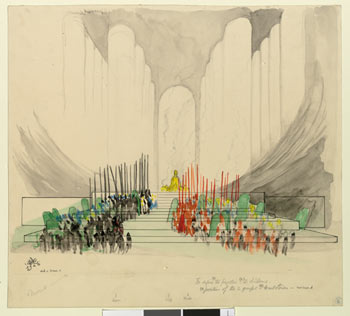
When Craig presented the opera with his friend and colleague Martin Shaw, he had only a plain blue background. This challenged the busy, realistic stages of the Victorian era, but this background is still used today, has almost become a staple for a production of Dido and Aeneas. Craig was not rich and was merely making use of the resources available to him, but he used them simply and efficiently, in the best way possible. 
Many of Craig's often-reproduced images have coloured perceptions of opera ever since the first staging. His approach advanced the idea of an entire production in the hands of one designer, a modern focus we now take for granted.
Dido and Aeneas was Craig's crucial first appearance as a designer. 
He interpreted the opera through vision and movement rather than through music.

Facts and theories


  • He had been put onto the stage by his mother (a famous actress) at 16, and performed under Henry Irving. He soon became dissatisfied with his performances as an actor, and retired. 
  • Craig began his work in the field of scenery, and W.B.Yeats stated that scene-painting 
    ‘would be a new and legitimate art appealing to a taste formed by itself and copying but itself”. 
  • Craig said of his own theatricality that he took "particular care to be entirely incorrect in all matters of detail", very much the opposite of Lepage. 
  • Craig despises the manner in which all theatre people rely on the dramatist. He wished to restore theatre as an independent art. Craig has been hailed as one whose designs and theories influenced and inspired the 20th century, but who "explodes everywhere except upon the English stage." They must have not been ready. 
  • He said: "after practice, the theory", meaning that he would try something out and then figure out what it meant later. This was the best he could do with the resources he had, but his talent and creativity brought him success.
  • He wanted to remind the audiences of recurrent theatrical values- “those single images which serve for a thousand words, the associations which transcend real life while giving to that life a greater meaning”
  • He always looked to the future of theatre, saw no point in trying to reconstruct the past
  • He greatly appreciated puppetry: In his opinion marionettes were the last echo of some noble and beautiful art of the past civilisation. He said that they have now become low comedians.
  • He believed that masks where the “means” of expression and that without them, acting was destined to degenerate.
  • "The art of the theatre is neither acting nor the play, it is not scene nor dance, but it consists of all the elements of which these things are composed: action, which is the very spirit of acting: words, which are the body of the play; line and colour, which are the very heart of the scene; rhythm, which is the very essence of dance.”
  • Shakespeare never wrote stage directions because he considered them 'tasteless'
  • Acting is not an art. It is therefore incorrect to speak of the actor as an artist. Art arrives only by design. Therefore in order to make any work of art it is clear we may only work in those materials with which we can calculate. Man is not one of these materials.”
  • He believed that no non-borne actor should be taught to act, therefore he disagreed with Stanislavsky’s System, which said that he and his system could make a good actor out of any man.
  • His early works promoted verticals, arches, cliffs, towering walls
  • He developing the sliding panels and pillars to have easy flawless scene changes.
  • Theory that gesture ruins dramatic poetry, as dramatic poetry is to be read not acted thus they have nothing to do with one another
  • Acting in the eye more powerful and fast than any other sense
  • The director must be a visionary, unique, who "knows but no longer handles the ropes"
  • He defines theatre as a ‘place in which the entire beauty of life can be unfolded not only the external beauty of the world but the inner beauty and the meaning of life.’
  • The aim of modern staging : to intensify the reality of things
  • Against realism
  • Short-tempered. When something went wrong he would have 'explosions of anger'